• ENOCK ONLINE SITE

    Welcome to your new Gnomio site

    Now, you are in control!

    math courses from MIT ...(You can edit or remove this text)

Available courses

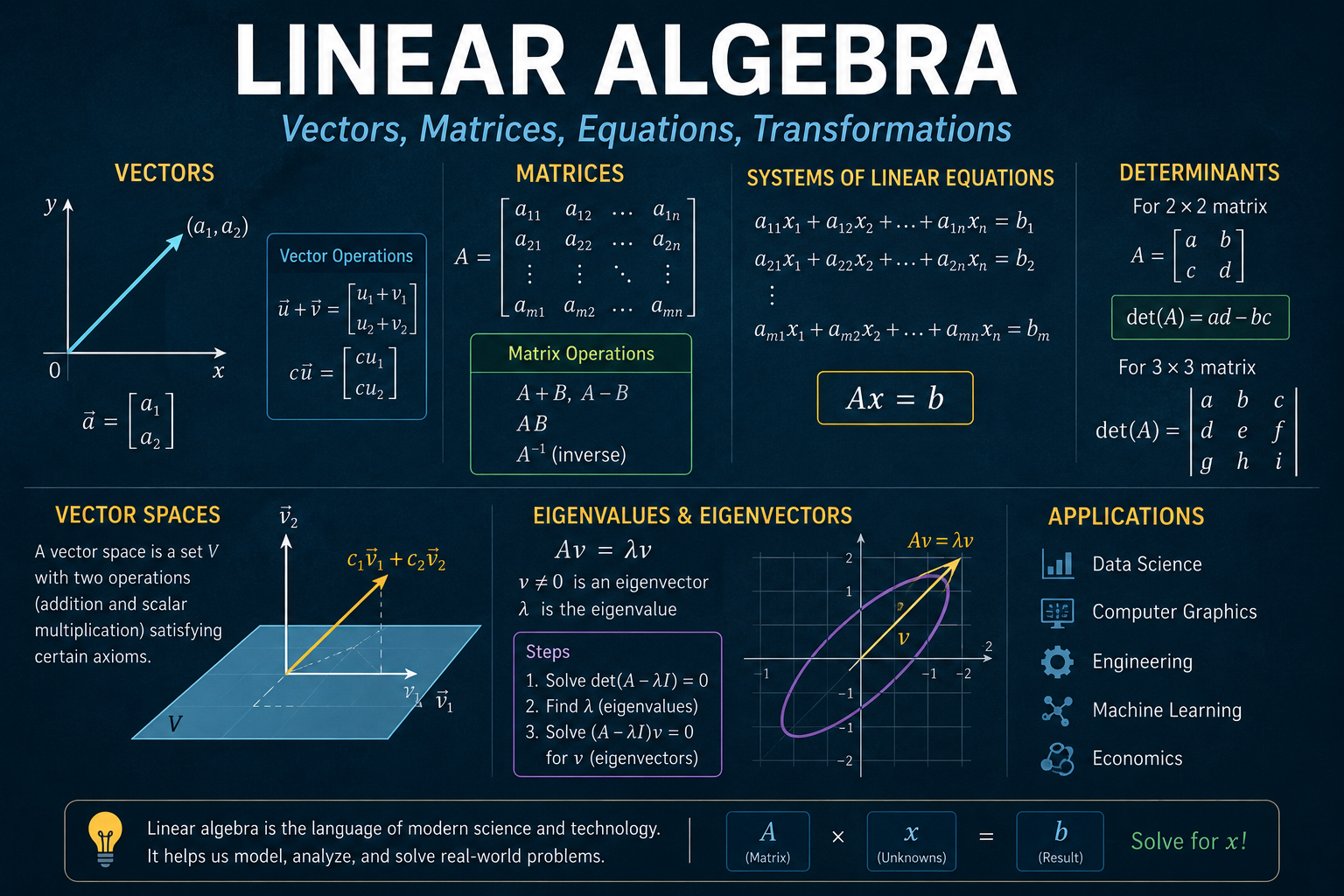
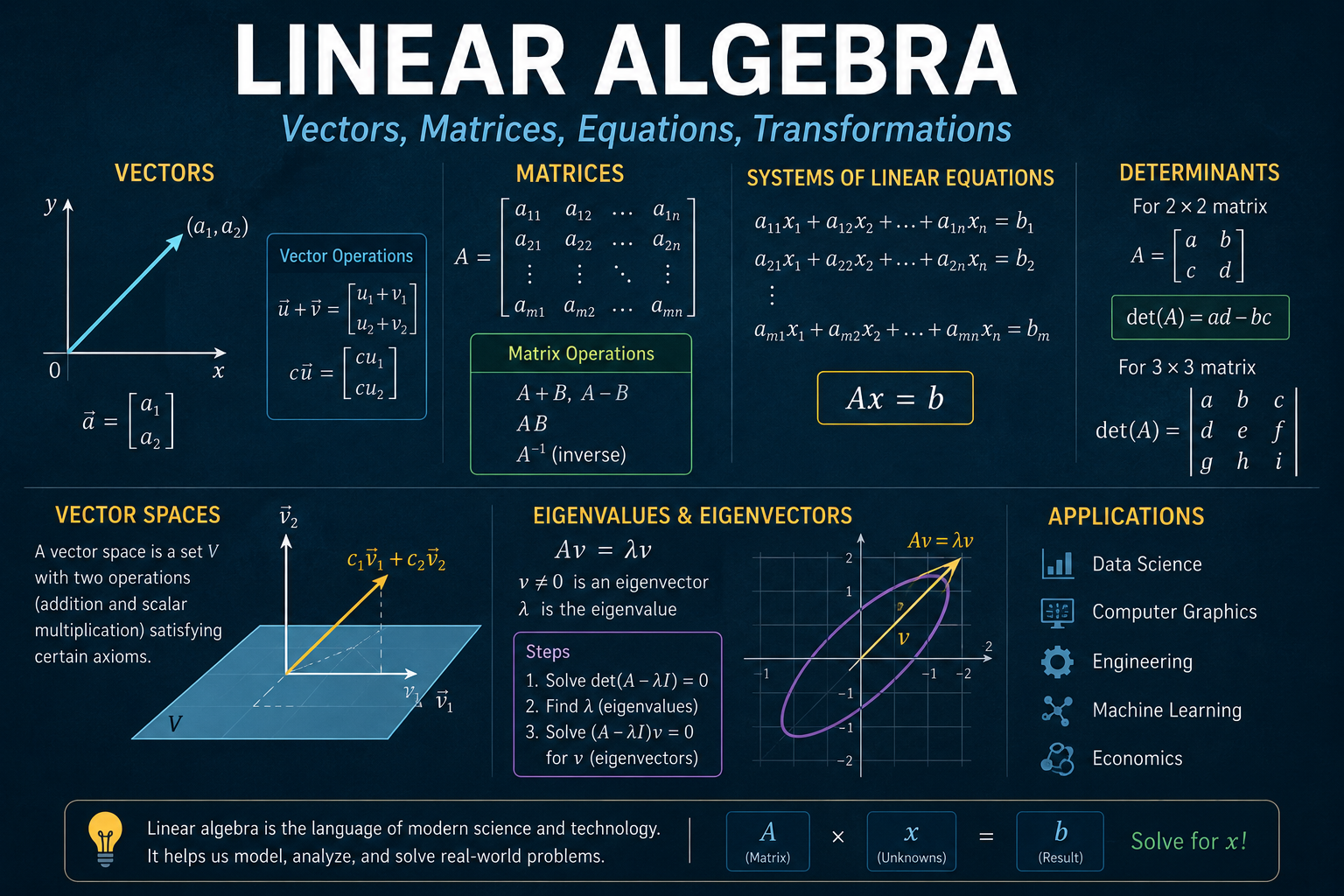
Linear Algebra is a branch of mathematics that studies vectors, matrices, systems of linear equations, vector spaces, linear transformations, eigenvalues, and eigenvectors. The course develops analytical and problem-solving skills and provides a foundation for advanced studies in mathematics, computer science, engineering, economics, data science, and physics. Students learn both theoretical concepts and practical applications of linear algebra in real-world situations.


Course Learning Outcomes

By the end of this course, learners should be able to:

  1. Define and apply fundamental concepts of vectors and matrices.
  2. Solve systems of linear equations using various methods.
  3. Perform matrix operations including addition, subtraction, multiplication, and inversion.
  4. Determine determinants and use them in solving mathematical problems.
  5. Explain and apply vector spaces, subspaces, and linear independence.
  6. Compute eigenvalues and eigenvectors of matrices.
  7. Analyze and perform linear transformations.
  8. Apply linear algebra concepts to real-world problems in science, engineering, and technology.
  9. Use mathematical software and calculators to solve linear algebra problems.
  10. Demonstrate logical reasoning and mathematical communication skills.

Course Learning Interactive Activities

1. Matrix Operations Workshop

  • Students work in groups to perform matrix addition, subtraction, multiplication, and inversion.
  • Use worksheets and calculators to verify answers.

2. Solving Linear Equations Activity

  • Learners solve systems of equations using elimination, substitution, and matrix methods.
  • Group discussion on different solution techniques.

3. Matrix Multiplication Demonstration

  • Visualize how rows and columns interact during multiplication.
 
(AB)11=20\left(AB\right)_{11}=20
Row
Column
 
(AB)11=(25)+(11)+(33)=20\left(AB\right)_{11}=(2\cdot 5)+(1\cdot 1)+(3\cdot 3)=20

4. Computer Laboratory Exercises

  • Use software such as MATLAB, Python, GeoGebra, or Excel to solve matrix problems and create visual representations.

5. Vector Representation Activity

  • Plot vectors on graph paper or digital tools.
  • Perform vector addition and scalar multiplication.

6. Eigenvalue and Eigenvector Investigation

7. Problem-Based Learning

  • Analyze real-life applications such as network analysis, cryptography, economics, and data science.

8. Peer Teaching Sessions

  • Students explain assigned topics to classmates and solve examples together.

9. Quiz and Reflection Activities

  • Short quizzes after each topic.
  • Reflection journals on learning progress and challenges.

10. Group Project

  • Develop a practical application of linear algebra, such as image processing, machine learning, or traffic flow analysis, and present the results.

This course provides students with a comprehensive understanding of mathematical concepts and problem-solving techniques. It covers fundamental theories, analytical methods, and practical applications of mathematics used in science, engineering, business, and everyday life. Students will develop logical reasoning, quantitative analysis skills, and the ability to model real-world problems using mathematical tools.